Showing posts with label science. Show all posts

Friday, March 3, 2017

Read Across America and March Math Madness

I love Dr. Seuss books and so do Genevieve and Tobias, so we are using the whole week to celebrate Read Across America.  The rhymes are fun.  Illustrations are friendly.  Some words are ridiculously silly.  And there are great lessons, like conservation, humanitarianism, and being willing to try something new.

On Sunday, we read The Lorax.  We decorated some ceramic planters.  Genevieve made her own, Tobias helped me make one, and we had to make one for the cat.  We started a science experiment, testing whether seeds would sprout better on top of the soil or in wet paper without dirt.

On Monday, we read Horton Hears a Who, Horton Hatches an Egg, Yertle the Turtle, and And to Think That I Saw It on Mulberry Street.  We chose these books because they all feature animals you might see at the zoo.  Genevieve made a map of the zoo and also made some charts to fill in at the zoo.  We were scientists studying animal behavior and counting animals by classification.  She kept noting the animals that had hair like her, and were therefore mammals. We also had fun marching in our own parade in honor of Mulberry Street.

On Tuesday, we were going to explore rhyming words.  Oddly enough, Mr. Dan chose to point out rhyming words in the books he read in story time.  We played with our rhyming fish.  Genevieve also enjoyed finding rhyming words to finish my sentences.  She played a game with Wonder Red from Super Why on the PBS Kids app.  We also read some of Dr. Seuss's sillier, tongue-twisting rhymes like Hop on Pop, Fox in Socks, Oh Say Can You Say, There's a Wocket in My Pocket, and One Fish Two Fish Red Fish Blue Fish.  Genevieve relived the fun of yesterday, painting a giraffe.

Wednesday is busy with two gymnastics classes, park time, and dance but we found some time for Seuss.  We read Bartholomew and the Oobleck, which is one of the few non-rhyming Seuss books.  We also celebrated the beginning of March Math Madness by reading Hoot which counts to 5 and names colors.  We made our own oobleck, using math and measurement skills.  We used cornstarch and water in a 1:1, 2:1, and 1:2 ratio.  Each had a different color.  Then we played with our non-Newtonian fluid, watching it turn from solid to liquid and back again.  Since Bartholomew helps the king with the weather, we observed the weather outside.  Then we made cloud paintings with cotton balls, and shaving cream mixed with a little glue.

Thursday, we read Green Eggs and Ham and Cat in the Hat.  We used this as a prompt to try new food so we tried some dragon fruit, which they loved, and star fruit.  We read Pumpkin Countdown, which is a rhyming book which counts down from 20.  We played with our spatial reasoning skills, playing the Three Little Pigs game and with tangrams.

Friday, we went to a rainbow sign class, where we learned color signs.  We read The Butter Battle Book and her favorite, How The Grinch Stole Christmas.  After enjoying all these different books, Genevieve created a book on her own.  She drew pictures and used stickers, and then told me what happened on each page.  It was about the weather.  She also made a bookmark.  We read The Chicken Problem.  She recently discovered Peg +Cat games on PBS Kids, and enjoys the chicken dance game.  So we had a dance party, practicing patterns and she repeated my movement patterns.


Monday, January 2, 2017

Sacramento children's museum

We visited the Sacramento Children's Museum recently with some family.  It's an interesting place.  Having worked at the Duke Energy Children's Museum in Cincinnati gives me a different perspective when I visit these types of places.

It's not exactly in Sacramento, but in Rancho Cordova.  Parking was relatively easy on the weekend.  It shares the parking lot with City Hall.  There is a tiny shopping area at the entrance, but not a full gift shop and no cafe.  But it isn't far from a number of restaurants if you do need food.

The price itself was reasonable.  They offer military and other discounts and are with ASTC, which means it won't hurt to ask about a discount if you have a membership to a museum.  Another great thing is that kids under 1 are free.

Once past the front desk, Tobias and Genevieve went straight to the train table.  It's a great height for them although they couldn't reach the boats well.  They weren't there long before they were called to the side where there was a large tower of foam blocks for Tobias to try to knock over and a giant light bright to distract Genevieve.  She wasn't quite sure what to do with the pegs, but was fascinated by it.

When she pulled herself away from the wall, she ignored the small sand area as it was slightly hidden and the play house.  Instead she went straight to the tubes on the wall which used air to create vacuums and propel scarves or foam balls about.  She loves these types of activities.  It was a little tough for her to move the pieces herself but she kept trying.  She experimented in rolling balls on the ramp as well.


On the other side of that wall, they created a sensory experience by hanging pool noodles from the ceiling.  Genevieve enjoyed traveling through the area but it didn't last long.  My main concern with this area was that it is difficult to watch your child through the hallway, which means you are either going through with them, which means they are missing out on experiencing this independently and you are getting hit with pool noodles, or you are going back and forth to keep your eyes on both sides.  Not as much of an issue with older kids when you can stay back further, but since this was new for Genevieve we wanted to keep a closer eye.


While she played there, Tobias went to the baby area with daddy.  It's a safe crawling place but he quickly bored.

Meanwhile, Genevieve headed to the art room.  She didn't really join in with the activities at the table but delighted in being able to paint the window.  They do a pretty good job of cleaning up space for new kids without making the area to wet.

Finally came the highlight of Tobias's day.  In the back corner, they have a water area.  There are several different tables at different levels and with different designs.  Tobias spent most of his time at a table by a Duplo wall.  The Duplo were meant to play in the water and on the wall, and the table was the right height.  The other tables had flowing water, to play with currents, control flow with pipes, and experiment with fountains.  Genevieve tried these out.  They have a few jackets to keep clothing dry, but I would definitely recommend extra clothes for little ones.

Genevieve tried those other tables out but left to play in the town before Tobias was done in the water.  She ended her day on the stage, admiring the fact she was also on TV.


Saturday, December 3, 2016

Getting Ready for Winter (and the Holidays)

This week we are beginning to decorate for Christmas and learning about what animals and plants do to get ready for winter.

We read The Sparkle Box, which is a great reminder or introduction to kids about giving to others during the holidays.  The back of the book has a sparkle box you can make, so we made ours and have started filling it with good deeds.  The Night of Las Posadas is a Tomie dePaola Christmas story, talking about the tradition of Los Posadas or the reenactment of Mary and Joseph's search for a place to stay the night.  In his story, the people chosen to be Mary and Joseph become snowed in but luckily replacements show up.  Merry Christmas Strega Nona is another in Tomie dePaola's Strega Nona series.  Big Anthony is tired of all the work Strega Nona is tasking him with to get ready for the big Christmas feast she prepares for the town.  But when Big Anthony gets distracted and forgets the shopping, she worries everything is ruined.  Instead, Big Anthony surprises her.  Dream Snow is an Eric Carle classic with counting to 5, farm animals and a farmer that resembles Santa Claus.  Bear Stays Up for Christmas is another book in the bear series.  It has a catchy rhythm, can be a reminder about hibernation, and demonstrates the wonder of giving.  Runaway Dreidel is a cute Hanukkah story set to T'was the Night Before Christmas.  It includes some typical traditions and reminds readers of the letters on the dreidel.  Llama Llama Holiday Drama is a reminder of how difficult it can be to be patient and wait for the holidays when there are so many reminders.  It also reinforces that the important thing is to spend time with family and friends.  The Clown of God is a story by Tomie dePaola that may bring a tear to your eye as a juggler performs his beautiful act as a Christmas present to the statue of Mary and a young Jesus.


We are still working on making Christmas presents and getting ready to send them out this week.  We decorated reusable bags with glitter glue in Christmas shapes like trees, presents, snowmen and more.  We also decorated plastic ornaments in different ways.  We filled them with pom pom or tissue paper and painted some with tempera paints and glitter glue.

The Busy Little Squirrel was a fun book.  All the animals wanted to spend time with squirrel, but he was too busy gathering food for the winter.  Baby Animals in the Snow is a short introduction to some animals that live in cold places like penguins, polar bears, snow leopards and Arctic foxes.  When Will it be Spring is the story of Alfie bear who is too excited about springtime to hibernate through the winter.  Chaucer's First Winter follows Chaucer the bear as he ignores the fact bears are supposed to hibernate and instead discovers some of the fun things to do in the snow.  Bear Snores On is the first of the bear books in Karma Wilson's series.  It follows a predictable word pattern which is great for early readers and examines several animals who stop in bear's cave to warm up while he sleeps.  We also read a National Geographic book about penguins to explore another cold weather animal.

We've been to the zoo and a petting zoo this week and have noted differences in animal behavior as well as thicker winter coats.  For instance, the lion and tiger were sleeping but the snow leopard was really active, which we don't often see.  We also have been talking a lot about the changes we see in plants, and how trees have list their leaves so they can sleep for the winter.  We created a hibernation cave, setting up a comfy place to sleep.  We also demonstrated migration, talking about the butterfly episode of Wild Kratts.  Under Frozen Pond is another great Wild Kratts episode for this topic.

On a side note, Tobias has really been demonstrating his sense of rhythm this week, dancing or bouncing to all sorts of tunes.  Genevieve keeps reminding me that I told her the myth from Ovid's Metamorphosis about Narcissus and Echo as we walk through the tunnel under the train tracks near our house.  She likes to say echo as we walk through the tunnel so I shared the myth and now she likes to remind me "turned to flower.". She's also really been enjoying the holiday specials on Amazon Prime.  Snowy Day has been changed from Keats' original story of a snow day into Peter getting ready for Christmas and meeting friends along the way who share their holiday traditions.  She prefers If You Give a Mouse a Christmas Cookie, based on the Laura Numerous books with mouse, moose, dog, cat and pig all working together to save the holiday play.

Saturday, September 24, 2016

Why Do Leaves Change Colors in the Fall

Why do leaves change colors in the fall
Leaves are an important part of any tree.  During the spring and summer, the chlorophyll inside them uses sunlight to turn water and carbon dioxide into oxygen and sugar in the form of glucose in a process called photosynthesis.  Like an animal preparing for hibernation, plants create extra glucose to help them through the winter.  As the shorter, colder days of fall begin, plants must consider what to do with their leaves.  Some plants, called evergreens, have leaves built specifically to survive the winter, either with minimal surface area or waxy coatings.  Other trees prepare to lose their leaves, but as they do they create a wonderful palette of color.
Greens, yellows, and orange
The green found naturally in leaves is created by chlorophyll.  Another chemical in leaves, called auxin, maintains a part of the leaf called the abscission layer.  As fall begins, the cooler days prevent the creation of more auxin.  The abscission layer grows and prevents the tree and leaf from sharing any more water or nutrients.  Without water, chlorophyll begins to fade, allowing other colors to show through.  Oranges and yellows are often already present in the leaves, in the form of carotene and xanthophyll.
Reds and purples
Some trees, like maples, use glucose trapped in the leaves to create a chemical called anthocyanin.  Some scientists have suggested anthocyanin may help a tree keep its leaves longer, as it lowers the freezing point of the leaves.  This may allow the tree to collect as much nutrition from the leaf as possible.
Browns
Brown colors in leaves are caused by a waster product named tannin.
Where to find the best colors
Weather plays a large role in color production.  In order to produce the best colors, the trees need to experience a warm and wet spring, followed by a temperate summer and an autumn with bright sunny days and cool nights.  The national forest service provides a hotline which offers information about the best color displays.  The scenic byways in thirty-one states have also been designed to best display the fall colors.
When looking for a particular color, keep in mind that colors are often characteristic of a species.  Oaks, high in tannins and anthocyanin, are often reds and browns.  Hickory leaves turn a golden bronze, while aspens are golden yellow.  Dogwoods can nearly be magenta, with their combination of purple and red.  Beech trees typically have tan leaves.  Black tupelo leaves are crimson red in the fall.  Maples vary by species.  Red maples, with their extra glucose, turn scarlet.  Sugar maples allow a little more of the carotene to shine through and are a fiery orange-red.  Black maples are a brilliant yellow and striped maples nearly lose all their color.
Not a leaf wasted
The abscission layer of the leaf eventually loosens the leaf enough that it will fall easily.  These leaves serve as food for all sorts of decomposers, which in turn help to restock the nutrients in the soil and help hold water.  Scientists have also proposed that chemicals like anthocyanin in leaves may help avert the growth of other species.
For those that love the fall colors, and would like some science experiments to accompany a leaf exploration, Science Made Simple has some great experiments.

Talk Like a Pirate and Welcome to Fall

We began the week celebrating Talk Like a Pirate Day.  My husband was stationed in Hampton, Virginia before where I taught at the local history museum about Blackbeard and a Blackbeard Festival was held so we are well versed in pirates.   I also worked at the Duke Energy Children's Museum at the Cincinnati Museum Center while the Real Pirates exhibit came through.

Some interesting pirate facts to share.

  • It was actually bad to be a well-known pirate, because that increased the number of people hunting you down unless you were a privateer like Sir Francis Drake who had the protection of the crown because he only attacked ships of political enemies of his home country.  
  • There were some female pirates, but they often disguised themselves as men.  Anne Bonny and Mary Read both served with Calico Jack.  One night, their ship was attacked by the Navy and many of the men were too drunk or scared to fight but Anne and Mary tried to fight.  The men were hung for the crime of piracy, but the women were both pregnant so they were sent to prison.  No one knows what happened to them then.  
  • X marks the spot comes from Treasure Island by Robert Louis Stevenson.
  • There is no evidence of a pirate walking the plank.
  • Life as a pirate was rough, but there was a pirate code that tried to keep things fair in the ship.  The treasure was divvied up by the quartermaster according to the rules.
  • The Jolly Roger was not the only pirate flag.  Pirates often created their own flag to identify themselves to other pirates.  


We started with some pirate stories.  Pirate Princess is about a girl who wants nothing more than to give up being a princess to become a pirate.  She struggles at first with the hard work, but soon uses her skills at finding treasure to impress the crew.  Victricia Malicia, on the other hand, was born into a pirate family but didn't feel like she belonged.  All she wanted to do was read.  In Pirate Girl, a group of ferocious pirates capture a little girl at sea.  She tells them they will regret it, and they do, when her mother's band of pirates attack.  Roger the Jolly Pirate is a fun take on how the Jolly Roger came to be known as the pirate flag.  It's written and illustrated by the same guy who illustrated the Lemony Snicket Series of Unfortunate Events.

We created our own island to bury treasures using a silicon ice cube tray.  First we added beads for treasure.  Then we buried them using a combination of baking soda and dyed sand to represent different parts of the island like sand and plants.  We used some watered down liquid water color to represent water.  The silicon tray made it easier to do the next part, where we created a map of our buried treasure.  The tray provided a nice grid for us to start from.  Then came the hard part, remembering where our treasure was buried so we could mark it on the map.  Then we took our island to the sink, where we used vinegar to wash away everything to reveal the treasure.  It's great to include mapping skills with pirate themes whenever you can.

We also created our own pirate flags.  I gave Genevieve the choice of dark felt or black paper.  She chose black paper and glitter glue, although we could have used chalk as well to get a nice image.  After Genevieve made her own flag, I had her talk me through things I should include on my pirate flag to let people know that I am coming.  We played her Jake and the Neverland Pirates matching game as well.

Other great pirate activities to do at home include creating treasure chests, playing pirate dice. or creating your own scrimshaw.  Pirate dice, or liar's dice, is the game played in Pirates of the Caribbean.  Each player should have a cup and 5 regular dice (6-sided).  Shake the cups, then place them upside down on the table.  Each player may look at their own dice.  Then the first player will use the number of ones in their cup to guess how many ones there are on the table.  The next player can increase the number of ones they think there are or guess the number of twos.  Once a player moves on to the next number, players may not go back to guess previous numbers.  At any time a player may call another player a liar if they believe they have overestimated the total of the current number.  Scrimshaw is beautiful carved artwork.  And although I wouldn't recommend carving into bones with your kids, you can carve soft white clay or create plaster medallions and cover them with wax that is easy to carve.

We also have been celebrating the start of fall.  We read Stellaluna, as well as Verdi and Pinduli by Janell Cannon.  Stellaluna is about a bat that spends some time living with birds.  We read 5 Little Pumpkins, The Fierce Yellow Pumpkin, and Ready for Pumpkins as Genevieve loves pumpkins.  On a similar vein, we read Sophie's Squash about a little girl who adopts a squash as a plaything.  We also enjoyed Storm is Coming and In the Leaves which is a great story where a boy explains some Chinese characters while on a trip to a farm with friends.

We did some great art and science experiments.  First Genevieve made a fall wreath and garland from a pumpkin cut out kit.  We decided to color some plants, so we split the bottom of a piece of celery with leaves and placed each side in a cup with different liquid watercolor.  We also placed a white carnation in red liquid watercolor.  All the watercolors were watered down.  We watched to see throughout the day how the plants might change.

We also did a little chromatography.  Ours didn't turn out because my lab assistant wanted to add a lot of water, but you might have better luck if you try.  First we tore up two groups of leaves - one that had changed to red and one that was still green.  You could also grind them up.  Add a bit of rubbing alcohol (use with care as it is flammable and not something you want anyone drinking).  Then we added a bit of water (warm water will help speed up the process).  Let that sit a bit, while you prepare a coffee filter by cutting it into strips.  When the water is colorful, dip the tip of the coffee filter into the liquid and you can watch the color travel up the strip.  Colored stripes should stop at different points along the filter.

We tried candy chromatography as well.  I'd recommend Skittles, but you can use M&Ms or gummies too.  We used a similar technique to the leaves, to which of course we added too much water.  Another option is to wet the candy a bit and use the liquid to draw about half way up the coffee filter strip.  Dip the tip in water and a little bit of rubbing alcohol and watch as the liquid separates the colors used to make the coating.

We did a little math first with the Skittles.  We opened the pack and sorted them by color into little cups.  We guessed which color had the most candies.  Then we drew a chart to see which color actually had the most candies.

Saturday, August 27, 2016

Conservation

With very few classes this week, we've been doing some extra outside activities.  Monday we had a play date with a few friends near where Genevieve used to do sign classes.  We rode the kiddie train but couldn't ride the carousel because it was being worked on.

We had storytime on Tuesday.  Genevieve told me a story that Grandmum has been telling her on the way.  After, we went on a butterfly hunt which transitioned us well for the magnet hunt we did at home.  We used a magnet wand to see what types of things were attracted to magnets.  We talked about how magnets are used to sort out metal trash that can be recycled.  We played with our magnet art board, magnets on the refrigerator and magnet puzzle.

We also sang the magnet song, to the tune of The More We Get Together:
Some magnets pull together,
together, together
Some magnets pull together
and that's called attract

And magnets like magnets
And magnets like metal
Some magnets pull together
and that's called attract.

Some magnets push apart,
apart, apart
Some magnets push apart
and that's called repel

And magnets don't like plastic
And magnets don't like wood
Some magnets push apart
and that's called repel.

Wednesday we went to the zoo.  We looked at all sorts of different animals and watched some of the zoo keepers taking care of some of the animals.  We noted that some animals don't like the heat so have to find ways to keep cool.


Thursday we tore up some paper and put it in a large tub with water.  We added some seeds and played in the paper soup, tearing it up more as we played.


Friday we took the paper soup outside.  We used a screen and a brick to press out new recycled pages.  We also had fun making paper balls and throwing back and forth until they broke.  This way we recycled paper and created a flower bed.

Saturday, we reused our plastic containers for an art day after soccer.

We read some great books this week, dealing with the importance of nature and how to help the planet.  The Giving Tree by Shel Silverstein and The Lorax by Dr. Seuss have long been some of my favorites.  The Lorax is how one little action can make a big difference.  Miss Fox's Class Goes Green is a great example of how a class works together to help reduce, reuse and recycle.  Michael Recycle is a superhero who flies into towns and asks them to help the environment.  We also read My Brother, to review some of last week.  This book is told from the perspective of the younger sibling admiring their older brother, unlike most of the books we read last week which were from the perspective of the older sibling.

Saturday, July 30, 2016

Patterns

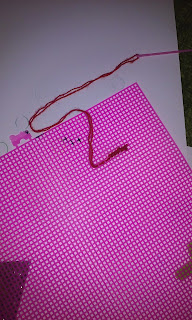
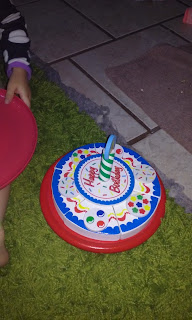
We started this week exploring simple patterns.  She "read" me a color book and a shape book to prepare.  Then we created patterns using colors, shapes, and size to make simple ab patterns.  We used her birthday cake toy to create simple abc patterns and noticed how this pattern places the same decoration opposite each other on the cake.  We read Bear Snores On, Bear Feels Sick, and Goodnight, Goodnight Construction Site and noted how these stanzas ended in rhyming patterns - abcb in the bear books and abab in the construction books.  We pulled out our rhyming fish and fished for some rhyming words as well.  She also pulled out her plastic canvas and practiced stitching, saying up and down as she pulled her needle through.
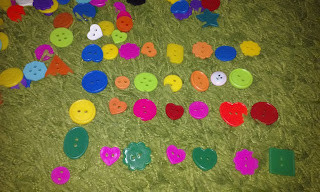
Tuesday we talked about more complex patterns.  We used our pasta to create rainbow color patterns.  We listened to Roy G. Biv by They Might be Giants and I sang my own rainbow song.  We also made patterns out of the shapes.  We also played with some stamps, noting the combination of colors on the stamps.  She tried to make her own pattern, creating a line of balloons.  We made patterns on her magnet board.  The shape magnets that came with it are great for this.  The cushion on the back is helpful for angling it well or for setting it comfortably on your lap.  The main problem is that the images are light and the erasing bar a bit difficult for her to move.  We explored texture patterns in her beads and in her foam alphabet floor tiles.


Books also have different types of patterns.  Instead of rhyme, Tuesday we looked at books that repeat larger ideas.  We read the Smallest Girl in the Smallest Grade, Two Friends: Susan B. Anthony and Frederick Douglass, and If You Take a Mouse to School.  We talked about how Two Friends had an introduction, then looked at Susan's childhood, had the quote "The right to live free.  The right to vote.  Some people had rights while others had none," then spoke of how she fought for rights.  Then it followed a similar pattern for Frederick Douglass, starting with his childhood, using the same quote and then addressing how he fought for rights.  We looked at how books like We're Going on a Bear Hunt and Let's Go Camping, which came with Violet, repeat chunks of text.  She loves We're Going on a Bear Hunt now, but it took awhile for her to get into the sound book because there is an image of a dog in a snowstorm that makes the sound of a snowstorm instead of a dog.  She used to get upset that it didn't bark.  But she likes the story and sound now, but parents be forewarned, this is a book that is great for kids but can annoy parents with its repetition.  We read I Love Saturdays y domingos, which has a pattern between sets of grandparents.  It's also nice as it includes some Spanish words.  We ended with Panda Bear, Panda Bear, What do You See and Peek-a-Boo Forest, which have sentences that repeat, with the slight change in animals in each page.
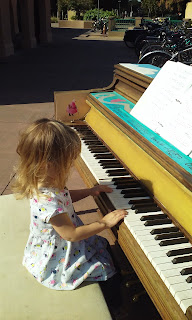
Wednesday we went back to dance class, and we realized music and dance are another place to explore patterns.  We listened to some musical patterns and tried to make our own with her various instruments.  We also practiced some movement patterns, with clapping and stomping.  We read one of my favorites, Zin Zin Zin, a Violin, which I love because it counts to ten, introduces different types of instruments, and uses some musical terminology.  We also read Do Re Mi, which was the interesting story of Guido d'Arezzo.  I didn't know a lot of this story, so it was interesting for me and written at a level children can understand.
Later we colored and worked on the Animals of the Alphabet book.  We had lots of R and S animals - raccoons, rabbits, rhinos, red pandas (which have long been an animal she loves, as it was the first animal she really reacted to at the zoo), snakes, sea dragons, sloths, sea horses, sheep, sea urchins, shrimp, sharks, sea stars, skunks, squirrels, scorpions, and seals.  She thought it was amazing how many ocean creatures there were.


Thursday we discussed routines.  We looked at bus and train schedules at the train station, and she built a train.  We looked at her calendar and I introduced some of her new chore options on her calendar.  The felt calendar is great because we can add things as we need them, but it doesn't always stick well.  There are some great options by Melissa and Doug instead, if you don't want to make your own.  There are activity and chore charts, but we combine these in our felt chart.  And yes, Genevieve does have chores at age 2.  She feeds the cat, sweeps, helps with laundry and dishes, waters the plants, and brushes her teeth and hair.  We talked about how her chores repeat and so do the activities.  We talked about how we feed the cat every day, but other things we only do once a week, like soccer and dance class.
Tobias had sign class on Thursday too.  This week was about getting dressed.  This week and the other classes fit this theme of patterns and routines as well.  So we talked about morning and evening routines and how these repeat.  Every night we watch Daniel Tiger while we clean up, then after Daniel we put go potty, put on pajamas, brush our teeth, share goodnight kisses, and then read many bedtime stories.  Daytime and nighttime are another type of pattern we also discussed

Friday we talked about some longer patterns, like how the moon changes, the 4 seasons, and life cycles of caterpillars.  Ready, Jet, Go has interesting episodes about the moon and perspective.  The younger character Mindy believes there are a bunch of different moons, and the older kids discover that this is not the case.  It doesn't necessarily bring up the lunar cycle, but it was a good launching point.  We've been observing the sky a lot in the morning and we've seen a large moon for a couple days last week.  We also saw some hot air balloons and clouds as a side note.
We watched the episode of Curious George with Hundley Junior, the caterpillar.  We read The Hungry Caterpillar and talked about the cycle a caterpillar goes through.  We looked at pictures of Genevieve when she was younger and compared them to pictures of Tobias.  So even though we don't go through the same changes of the caterpillar, we do go through similar growth patterns and learn skills in a similar order.

While talking about similarities, we also managed to have a few different versions of the Cinderella stories in the house at the moment, so we compared Raisel's Riddle, Mufaro's Beautiful Daughters, and The Talking Eggs to the Disney version, and Rexerella.  We looked for similarities and similar story arcs, and differences.

 Genevieve has been very interested in bones this week, so we also watched an episode of Dinosaur Train with Fossil Fred and read an introduction to the skeletal system.  Wild Kratts has been introducing new episodes with Chinese animals, and Genevieve loves pandas so we also read a little about pandas and monkeys in some National Geographic books.  We were also lucky to find a female duck in our yard and a camouflaged bug in the grass.